


LARGE SILVER TEA CADDY
About This Project
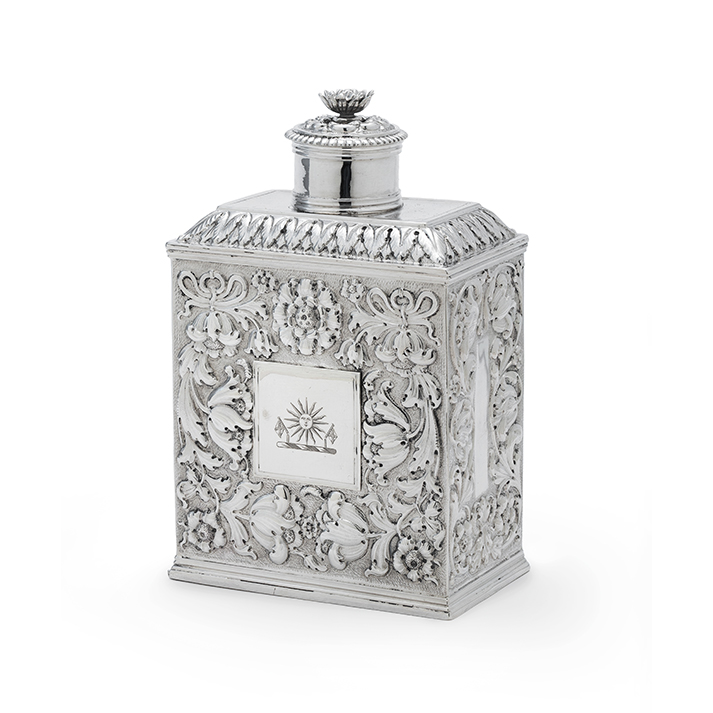
A large silver tea caddy
Sijbout Sijbouts Buma, Haringen, 1726
277 grams; 15,6 cm high; 6 cm wide; 9,9 cm long
The rectangular tea caddy with cylindrical cap is chased in high relief all around with bows and flower ornament on a matted ground. The sides have smooth surfaces in the middle, which are engraved in the front and back with an English crest, a shining sun, with a flag on either side The shoulders are chased with a band of stylized leaf ornament. The bottom is formed by a loose slide in order to fill the tea caddy. Two hearts are engraved on the bottom, including To MSK & GN. The detachable cap with profiled edges is crowned by a flower bud. Fully marked at the underside and displaying assay stripes.
The engraved crest belonged to John Lucas Rennie, Esq., of Wateringbury, Kent (1794-1874). John Lucas Rennie was born in London on August 30, 1794 as the second son of the famous engineer John Rennie the Elder (1761-1821). Engineer John Renniethe Elder is known for the construction of Waterloo Bridge (1811-17) and Southwark Bridge (1814-19) in London. John the younger took over the engineering work and the company from his father after his father’s death in October 1821. From 1824 he was in charge of the company G. & J. Rennie together with his brother George Rennie. From 1824 to 1831 he and his brother worked out the design of the London Bridge of their father John the Elder. The bridge was opened in 1831 by King William IV. John Lucas Rennie was knighted and was henceforth called Sir John Lucas Rennie. In 1835 John married Selina Garth Colleton at St Marylebone, London. He died in Bengeo near Hertford on 3 September 1874.
The preserved assay book (Keurloonboekje) of the Harlingen silversmiths’ guild lists the objects that the silversmiths brought in for inspection, with the weight in ‘loot’ and the assay fee that had to be paid. For example, this document states that in 1726 Sijbout Sijbouts Buma brought a tea caddy to the guild for inspection, with a weight of 17 loot, for which he had to pay 2-2 guilders as an assay fee. The weight of the tea caddy mentioned in this archive document is 17 loot, which corresponds to 262.5 grams. (1 loot is 15.44 grams). In this entire assay book the objects have not been recorded with the smaller weight indications of ‘engels’. The weight indications in the Keurloonboekje suggest the Harlinger guild was rounding off the weight. After all, the silversmiths paid an assay fee for each piece of silver they had made.
However, the fifteen grams extra is too great a difference. It turns out that the crests are engraved on two applied square plates. When calculating the applied silver, it appears that this must be a weight of about fifteen grams, which corresponds to the difference in weight. The tea caddy described here is fully marked with the silver hallmarks of Harlingen, and it appears to be the one in the assay book of Harlingen, presented by Sijbout Sijbouts Buma in the year 1726.


