


SILVER COFFEE POT
About This Project
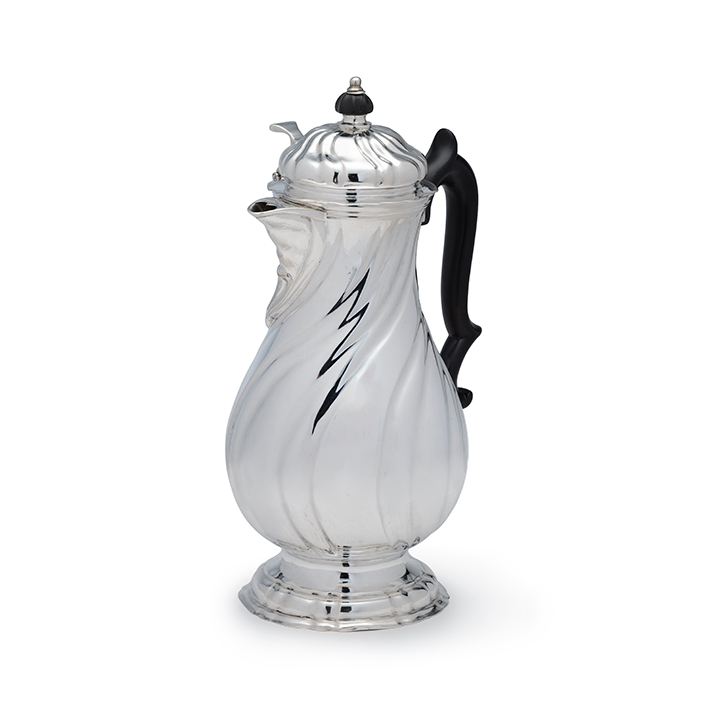
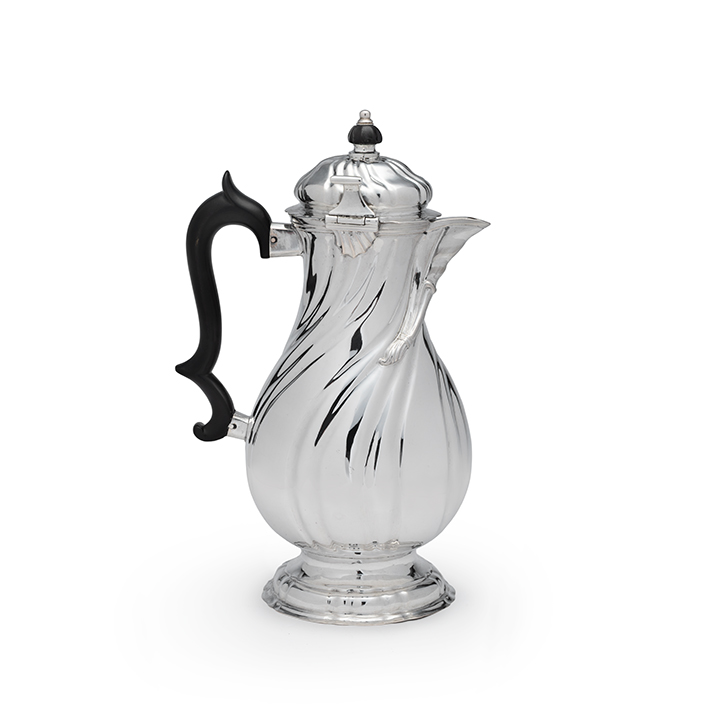
A silver coffee pot
Servatius Beckers, Maastricht, 1760-62
485 grams gross; 24.4 cm high
The baluster-shaped coffee pot is chased with asymmetrical lobes, as is the domed, hinged cover with finial and thumbpiece. The short spout with heart-shaped opening runs obliquely away from the twisted neck. The coffee pot stands raised on a domed base with scalloped rim and has a scroll-shaped handle. Fully marked on the underside near the base.
The silversmith
Servatius Beckers (1725-1775), son of Joannes Beckers and Anna Janssen, became a master silversmith in Maastricht in 1752. In 1762 he married Maria Anna Bauduin. He lived in the house ‘Rosenobel’ in Muntstraat and the house ‘De Ceulse Tesse’ in Grote Staat. Tilmanus Bauduin, his wife’s nephew, was apprenticed to his uncle Servatius, as were Godefred Goedin, Isack Lindeman and an unnamed apprentice. Servatius Beckers made very fine large silverware, both ecclesiastical and profane. Known of his hand for example are altar candlesticks and cruets on stand, but also very fine coffee pots and archer-guild plates. Servatius Beckers was thus an active silversmith. His works appear not only in and around Maastricht but also in Belgium. According to his biography he owned two houses.
The gable stones of both houses have been preserved. The house Ceulse Tesse also shows the symbol of a golden purse and a banderole with a chronogram: haeC Coolonlensls bVrsa Dat honoreM Urbi. The free translation of this: this purse from Cologne (or the man from Cologne) does honour to the city. This house functioned as a trading house with the city of Cologne and thus indicates the relations. The gable stone of the house Rosenobel refers to a coin, the rose noble. This gold coin was used from the 14th century until the 17th century and had a value of five ‘stuivers’. From this could be concluded that Servatius Beckers was not only a silversmith but also engaged in trading silverware (a retailer). The town of Maastricht is ideally located for trading with both Belgium and Germany, not only in silverware but also in other objects, such as furniture, clocks, etc. Unfortunately, no archival documents are known that can support the idea that Servatius Beckers also worked this way.


