


SILVER-GILT PLAQUE
About This Project
A silver-gilt plaque
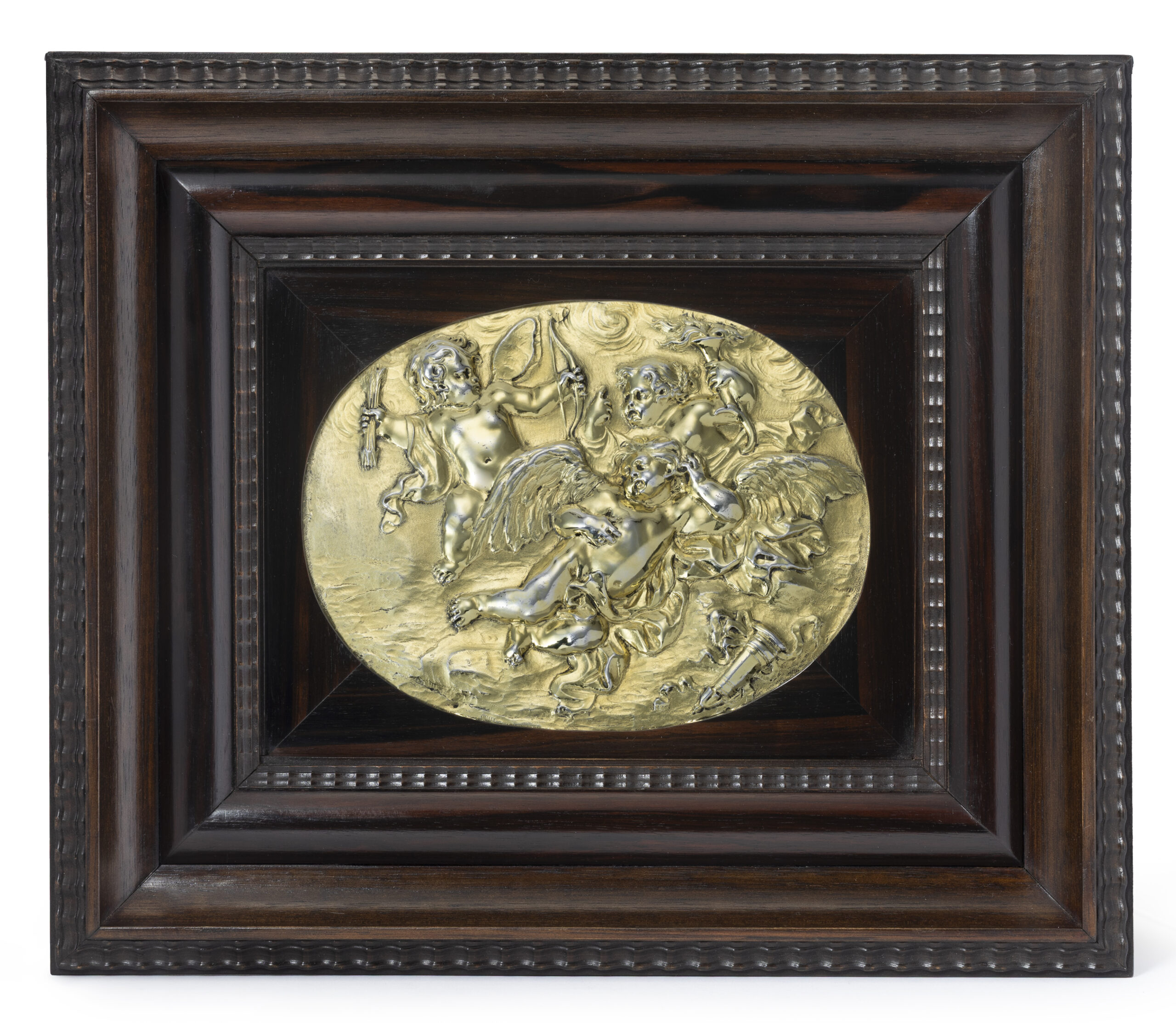
‘Sleeping Cupid disarmed by two putti’
unmarked, The Low Countries, circa 1660
Plaque 133 grams; 18 x 13.7 cm; with frame 33 x 28 cm
The oval fire-gilt silver plaque is chased in high relief with an allegorical scene of three winged cupids (amoretti or putti). One with bow and arrow, one with a burning torch, and one lying asleep on his back beside an empty quiver in the foreground. The oval plaque is mounted in a wooden frame.
The plaque was certainly part of, for example, a tazza, as the reverse of the plaque indicates . The silver of the plaque was examined on the basis of its alloy and the base metals present. The silver alloy is 932/1000, which points to the Low Countries.
Dating an unmarked plaque is only possible on the basis of comparisons. Most plaques that qualify for this were made around the middle of the 17th century. At the beginning of the second half of the 17th century putti are generally full-chested. Moreover, the pattern books were already becoming better known since they were widely distributed. Not depicting the same subject, but with the same appearance, are two bronze plaques recorded in Weber (1975). These plaques are after François du Quesnoy. The figures in them are similarly full-chested and have round faces. These are dated to the third quarter of the 17th century.
Allegorical scene
The Amorum Emblemata is regarded as one of the most important and influential of all emblem books. The collection was designed by Otto van Veen and first published in Antwerp in 1608 in three versions: Latin, French and Dutch; Latin, Italian and French; and Latin, English and Italian. Its success and popularity led to many further editions and adaptations, while the images were later used by decorative artists throughout Europe.
In making his book of love symbols, Van Veen followed a trend that began in Amsterdam in 1601 with the publication of Quaeris quid sit Amor, a collection of twenty-four love emblem prints made by the artist Jacques de Gheyn with accompanying Dutch verses by Daniel Heinsius. Van Veen’s volume is much more extensive and consists of 124 emblems. The lines on love that accompany and interpret the images are largely, but not always, taken from Ovid. The book, aimed at young people, describes love as an overpowering force that must be followed in order to achieve happiness.
The three cupids, the bow and arrow and the burning torch are iconic motifs in seventeenth-century love emblematics and have a specific meaning. The cupids personify the different facets or stages of love (often inspired by the classical struggle or harmony between Eros and Anteros (love and requited love). The bow and arrow stand for the ‘striking’ or piercing of the heart. It symbolises the inevitable onset of infatuation that overpowers the soul. The torch symbolises the fire of life, passion and the enlightenment that love brings. A burning torch stands for an active, lively love; when the torch is held downward or has been extinguished, this often symbolises death or the end of passion.
In the Amorum Emblemata, Otto Vaenius uses these motifs to convey moral and philosophical lessons about love to a young, courtly audience. Notably, the title page of the book often already shows a vignette with exactly these elements: a bow, arrows and a burning torch with the motto Amor Vincit Omnia (Love conquers all).
The third cupid chased in relief on this silver-gilt plaque lies sleeping in the foreground with an empty quiver beside him. It appears that the two other cupids have stolen his arrows and torch while he sleeps.
An emblem from the Amorum Emblemata (1608) shows the motto Amoris arma numquam deficiunt (the weapons of love never run out). Although Cupid’s quiver in the foreground appears to be empty, love produces its own ammunition and its power is inexhaustible. The title of this plaquette could therefore be ‘Sleeping Cupid disarmed by two putti’ (Amor Dormiens).


