


Two silver baskets
About This Project
Two silver baskets
Engelbert Joosten Sr., The Hague, 1766
260 grams; 17.8 cm wide; 7.5 cm high
and
Engelbart Joosten Jr., The Hague, 1764
266 grams; 18 cm wide; 7.5 cm high
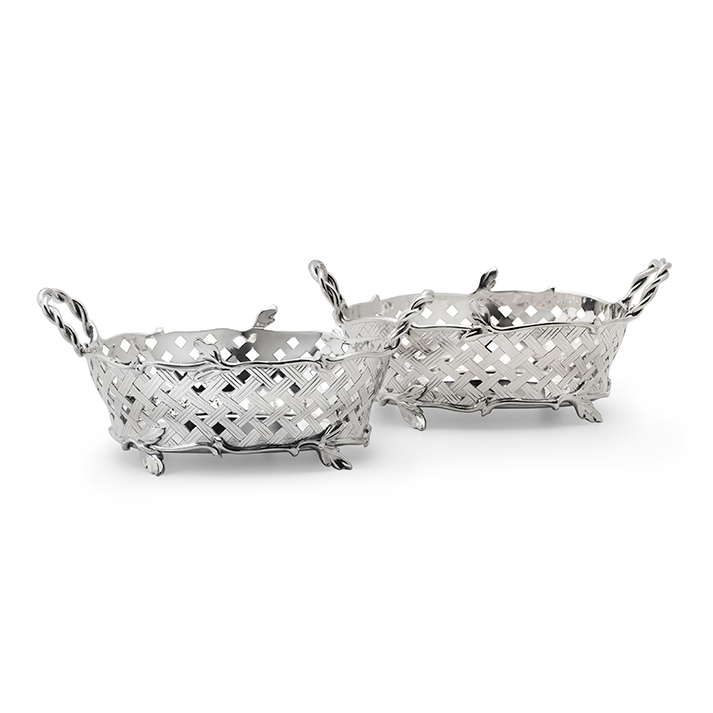
The oval baskets are pierced with simulating wickerwork and engraved between the edges, which are formed by twigs. The supports are formed by four leaves and the handles are formed by simulating braided ropes. Fully hallmarked on the underside and displaying an assay stripe.
The silversmith Engelbart Joosten Sr. was born in 1717 in The Hague. On 20 October 1737 he became engaged to Adriana van Vliet, who came from Scheveningen. Engelbart was admitted to the gold and silversmiths’ guild of The Hague in 1755. He died on 1 August 1789. His son, Engelbart Jr., was born on 30 July 1738. He followed in his father’s footsteps and was admitted as a member to the Hague silversmiths’ guild on 5 November 1764.
The oeuvre of Engelbart Jr. differs somewhat from that of his father. His father produced many large silver items such as tureens with underplates and baskets. Engelbart Jr. also made tableware such as baskets, fish servers, soup ladles, and cutlery. It appears that the father made the larger pieces, while the son focused more on smaller items. This likely relates to the fact that Engelbart Sr. had more connections with noble families. Like other Hague masters such as Samuel Busard, Reynier de Haan, and Godert van IJsseldijk, Engelbart Joosten Jr. applied the wicker decoration to baskets until approximately the 1770s. The wicker motif was possibly inspired by English baskets from the 1730s. Hague silversmiths often used flowing volutes, rocaille, and twigs as edge ornaments.
This small basket with wickerwork may be the only one we know of by Engelbart Sr. Given that his son Engelbart made a similar basket in 1764, it may indicate that the father increasingly left the production of these smaller baskets to his son.


