


A pair of silver casters
About This Project
A pair of silver casters
Maker’s mark IL with star, Rotterdam, 1783
Total weight 646 grams; 19 cm high
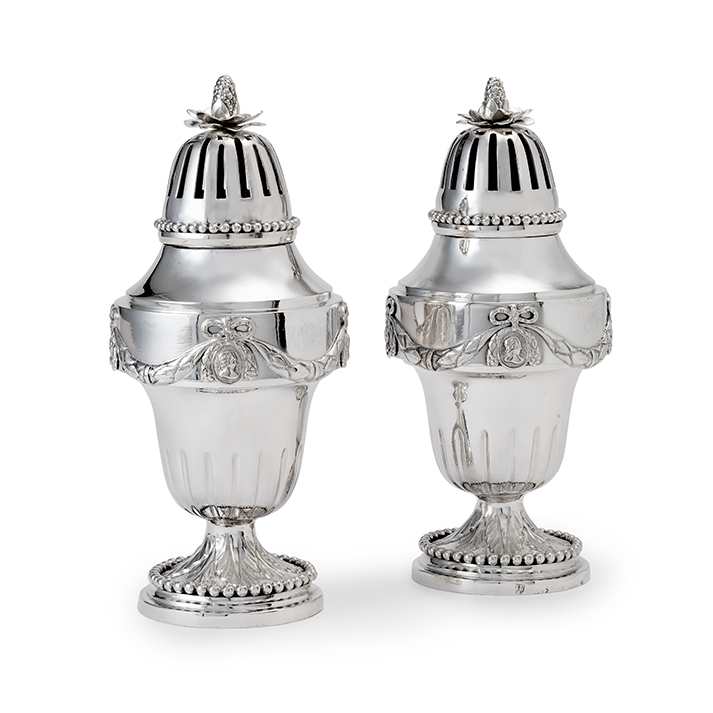
The casters, made in the form of garden vases, stand on a round base, chased with foliage and a beaded border. The lower part of the body is partially fluted and the shoulders are applied with swags and bows, suspending classical medallions. The high-domed, pierced and detachable cover with beading has a pinecone and foliage finial. Marks struck on the foot rims.
Both casters have been hallmarked, but on one only part of the maker’s mark is visible. The hallmarks on the other caster are worn, as seen in the images. The depicted marks—date letter, town mark, lion, and maker’s mark—refer to Rotterdam guild marks. The date letter, partially visible, corresponds to the date letter of 1783. The maker’s mark IL with star in contour has not been described in literature yet.
In literature the following silversmiths have been recorded, who can be possible candidates in this period: Balthasar Levit (1769–1794), Leonardus Leesing (circa 1777), and Johannes Stefanus Lucardi (1777–1821).
Based on the initials only, Lucardi could be the most likely silversmith. Several maker’s marks are known from him, but all without the clearly visible star in the maker’s mark, struck on the sugar casters. Nothing is known about Leesing, no maker’s mark and no biographical data. Thus, the only silversmith who could be considered is Balthasar Levit. It is known that this silversmith used multiple maker’s marks. In his known maker’s marks, he uses a star below the initials BL in a lobed cartouche. Although his maker’s marks begin with a B, the contour and star match a maker’s mark of his, that is struck on a table bell from 1788. Whether the maker’s mark should be attributed to Balthasar Levit is not clear. However, his father’s name was Jan Leviet and his son was named Johannes Jacobus Levit (b. 1776). It is not known whether his son followed in his father’s footsteps.


