


A Dutch silver mustard pot
About This Project
A Dutch silver mustard pot
Gerardus Wery, (Maastricht), circa 1695
183 grams; 16.5 cm high
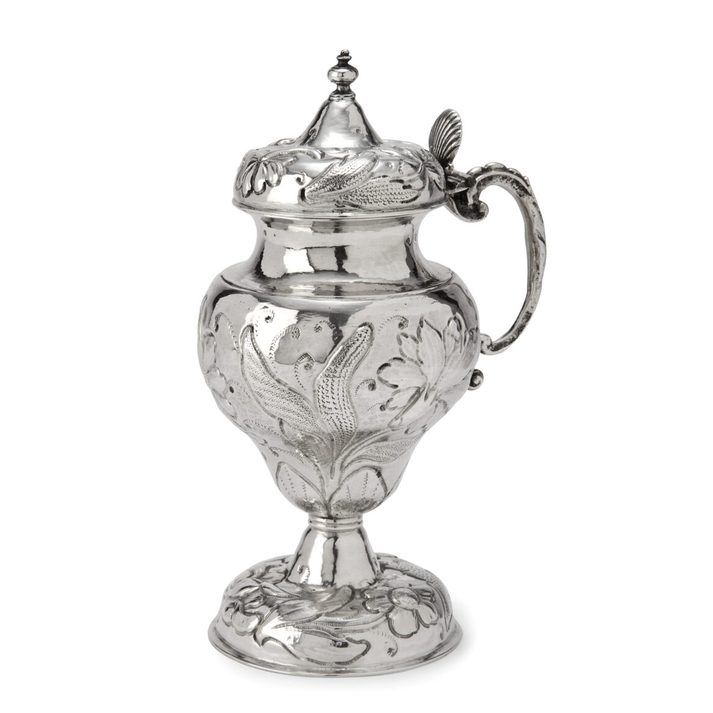
The baluster-shaped mustard pot with hinged lid is embossed with several species of flowers. It has a scroll cast handle and shell motif thumb rest. The lid has a pinnacle finial. The circular base is also chased with flowers and foliage. Engraved with the monograms MMV and BI on the body. Struck with a maker’s mark only at the plain neck.
Kerckhoffs states in Duurzame Glans (p.59) that the oldest known mustard pot dates from 1708/10, made by Petrus Klockers sr. (KKF 71) in Louis XIV style. That mustard pot is therefore completely plain in contrast to the mustard pot that Gerardus Wery made in the so-called floral style. Stylistically, the latter style period precedes the Louis XIV style period. It is possible that Wery’s mustard pot is therefore the oldest mustard pot, made in Maastricht. This mustard pot and also a salt cellar, which Wery made, are both decorated with flowers, might have been commissioned by the same person, also because of the similarity of the initials MMV, which appear on both salt cellar and mustard pot.
Gerardus Wery (1662-1718) was a silversmith from Maastricht, descending from a family of silversmiths. His father Anthonius, a blacksmith from Maaseik, took his civic oath on 25 January 1661. His mother, Margareta van Bloemendael, belonged to a family of gold and silversmiths from Maastricht. The marriage of his parents took place in the St. Nicholas Church on November 26, 1655. Gerardus shared his mother’s inheritance with his brother on 18 April 1705, his father had already died by then. Among other things, he inherited the house ‘de Kerpe’ on the Kerssenmarkt, at the corner of Smedestraat and further land and other goods that have not been named. His brother Fredericus and his son Johannes both worked as silversmiths in Maastricht.
Mustard pots, often with accompanying spoon and pepper caster, were also ordered from Gerardus several times and delivered by him. Until now, this mustard pot and salt cellar, both from the same collection, are the only preserved profane silver objects by Gerardus Wery that are known.
In the seventeenth century the import of exotic flower bulbs in the Netherlands triggered the appreciation for species, which we now consider to be typical Dutch. The tulip in particular became the ultimate status symbol, very desirable, which resulted in a short period of ‘tulipomania’, when extreme amounts of money were paid for a single tulip bulb. Painters were commissioned to capture expensive bunches of flowers on their canvases, the flower still life became a genre, and silversmiths started embellishing silver objects with floral decoration, derived from paintings, engravings and drawings, until the end of the 17th century.
Mustard has a long history as archaeological findings have proven. In Roman times mustard seeds would be ground and mixed with acidic juice of unripe grapes, thus made into a paste, similar to the one we are familiar with. In Europe mustard was used as a condiment way before spices were imported from Asia. Mustard was not only used for spicing up food, especially meat, but also for masking decay. Moreover, mustard was claimed to benefit health, both the seeds and the condiment.


