


Dutch silver snuffers tray
About This Project
Dutch silver snuffers tray
Jesayas van Engouw
The Hague, 1724
179 grams; 20.6 cm long, 12.5 cm wide including handle
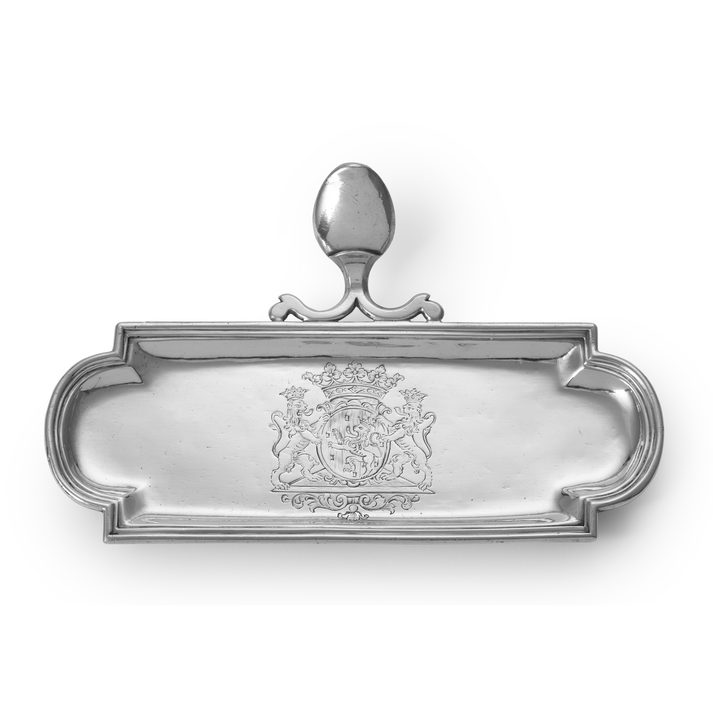
The snuffers tray is oblong in shape with a rising profiled rim and a protruding curve on either side. In the center a female coat of arms beneath a crown is engraved. The tray stands on four profiled feet. The upright handle in the middle of the long side has a plain, oval end. Fully marked on the reverse of the tray and additionally struck with a small control mark for Utrecht, in use from 1739, and with an assay stripe.
Candle snuffers were already used in the 17th century, but especially in the 18th century, in order to prevent candles from smoking. Therefore, the wick had to be cut regularly. These special scissors with an incorporated container offered a solution to cut. The silver candle snuffers that have been preserved are either part of a chamberstick set, or laying on a snuffers tray.
The silversmith
Jesayas van Engouw was born in 1675 and was admitted as a master to the Hague silversmiths’ guild in 1696. During the late 17th century and the first half of the 18th century he made a name for himself with high-quality silverwork in the Louis XIV and Louis XV styles.
Jesayas van Engouw was one of the important silversmiths in The Hague. He received various commissions from noble families and also from the stadtholder’s court. The Rijksmuseum in Amsterdam has a coffee urn with spout (kraankan) made by him in 1720 bearing the coat of arms of stadtholder Prince William IV (1711-1751). The Fraeylemaborg in Slochteren has a pair of sugar casters, made in 1719, also bearing the stadtholder’s coat of arms of William IV. Various works by the silversmith are known. An important object is a large silver tabernacle, made in 1720, which is still in use at the Old Catholic Church of the Netherlands.
Coat of arms
The engraved female family coat of arms can be attributed to the VAN STEPRAEDT family. Which female family member this snuffers tray belonged to cannot be stated with certainty, as inventory lists mentioning a pair of snuffers with tray are lacking. It may have belonged to Maria Agnes van Stepraedt, who was born around 1720 and married Willem Caspar Frans Anton Joseph van Doornick in 1743.
There is a portrait of Maria Agnes van Stepraedt as an unmarried young lady, with her coat of arms painted on the right, which corresponds to the coat of arms engraved on the snuffers tray. The portrait was painted by Gerhard Jan Palthe in 1729. Maria Agnes in the painting would then have been nine years old, if she was born in 1720. Her parents, Diederik Johan van Stepraedt and Johanna Elisabeth van Steenbergen, married in Wijnbergen on 24 November 1714. It is possible that Maria Agnes’ year of birth was earlier than 1720. In the painting Maria Agnes appears older than nine. Her parents were wealthy and had been allotted various estates and titles through inheritance. Her father was Lord of Doddendaal and owned the associated lands. Her mother was Lady of Nijenbeek. Through inheritance, Maria Agnes Stepraedt became Lady of Doddendaal, Indoornk, Loenersloot, Nijenbeek and Slangeburg.
The VAN STEPRAEDT family coat of arms also appears on an oval silver tray, likewise made by the Hague silversmith Jesayas van Engouw in 1727. The tray was probably used at a lady’s toilette. If the user was Maria Agnes, it appears that she already owned silver at a young age.
The small control mark of Utrecht, struck next to the hallmarks of The Hague, was in use from 1739. It is probably a reference to the object having presumably been in the possession of a family from Utrecht.
Maria Agnes van Stepraedt became the owner of Loenersloot Castle near Utrecht, which was owned by the family. Loenersloot Castle came into the family’s possession through Maria Johanna van Amstel van Mijnden, who married Pieter Reinier van Stepraedt tot Doddendael and Duistervoorde in 1679. The son of Diederik Johan inherited Loenersloot, but also Doddeldael and Ewijk. Moreover, his wife was the owner of De Slangenburg. Because of the large number of castles at the family’s disposal, they no longer lived at Loenersloot, but it was rented out to various people. After the death of Maria Agnes in 1769, Loenersloot Castle was sold to Hendrik Willem van Hoorn, who owned it until 1772.
The owners of Loenersloot Castle:
1515-1534 Amelis van Amstel van Mijnden
1534-1568 Jacob van Amstel van Mijnden
1568-1615 Joost van Amstel van Mijnden
1616-1633 Jacob van Amstel van Mijnden
1633-1658 Joost II van Amstel van Mijnden
1658-1684 Maria Johanna van Amstel van Mijnden
1684-1707 Pieter Reinier van Stepraedt as guardian of Diederik Johan van Stepraedt
1707-1744 Diederik Johan van Stepraedt
1744-1767 Maria Agnes van Stepraedt
Sale of Loenersloot to:
1767-1772 Hendrik Willem van Hoorn


