


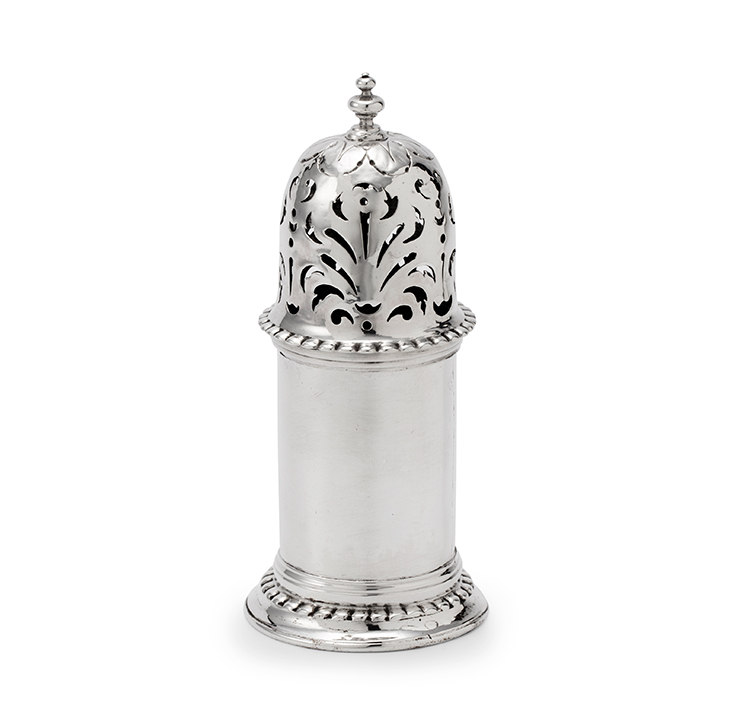
Dutch silver caster
About This Project
Dutch silver caster
Christiaan Warenberg
Amsterdam, 1715
152 grams; 13,5 cm high
The plain cylindrical body with profiled edge stands on a spreading round base with gadrooning. The high-domed pierced and detachable cover has a protruding gadroon border and is surmounted by a bell-shaped finial, surrounded by a chased foliate rosette below. Fully marked at the reverse of the body and displaying an assay stripe.
Christiaan Warenberg was born in Augsburg in 1667, the son of silversmith Erhardt Warenberg and Anna Maria Ment. He was one of the many German immigrants who came to Amsterdam to settle because of the favorable economic climate and freedom of religion. On 27 January 1696 he became a burgher of Amsterdam, and around that time he joined the Amsterdam silversmiths’ guild. He married twice. In 1699 Anna Jonston in Breda and in 1707 Alida Soetemans. He lived in the Kalverstraat, where he died in 1747. Christiaan Warenberg was already considered as one of the most qualified silversmiths in his time, as stated in the register that was drawn up by Pieter de Keen in 1710 and 1716 on behalf of the city council.
As a Lutheran, he was commissioned to make a silver communion set by the Old Lutheran Church in Amsterdam. In 1726 the church received two lidded chalices and a tazza for worship. The Rijksmuseum Amsterdam has a pair of pricket church candlesticks from 1710 in its collection, made by Christiaan Warenberg. In the same collection is a coffee urn with three taps from 1717 by his hand.
more information, click here


