


Exceptionally large coffee urn
About This Project
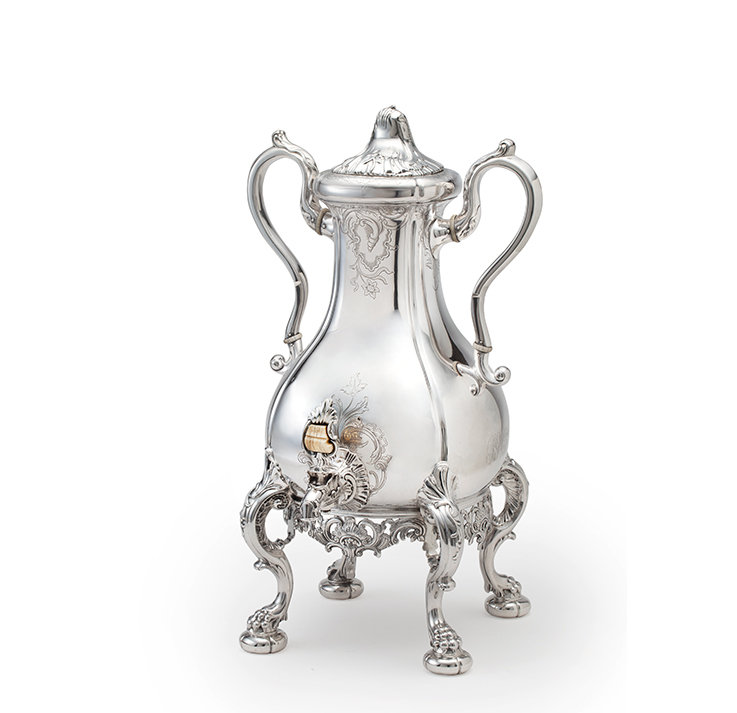
Exceptionally large Dutch silver coffee urn (kraantjeskan)
Matthijs Craayenschot
Amsterdam, 1760
3328 grams; 42,5 cm high
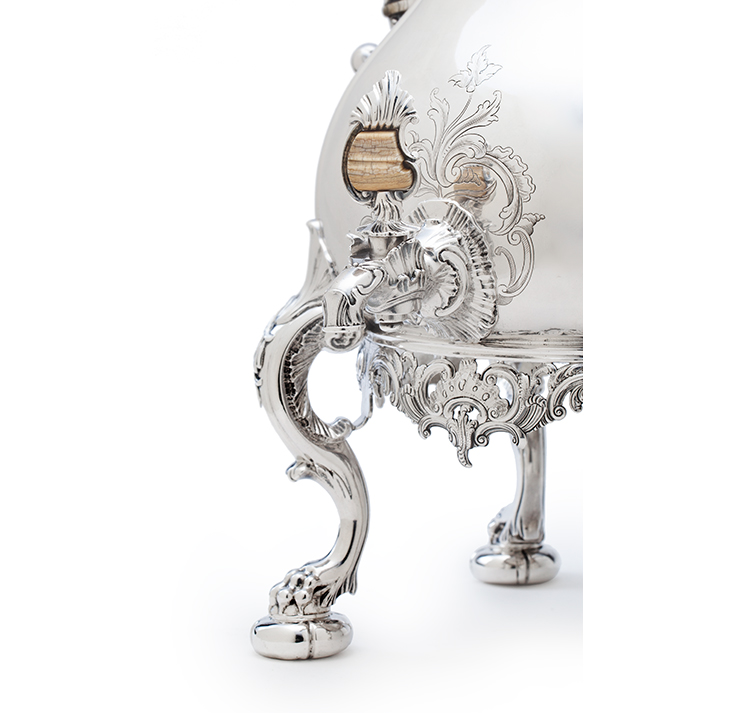
The pear-shaped urn is raised on four openwork scroll supports and has a pierced scroll border below. The two rocaille spouts on either side are fitted with rocaille spigots inlaid with mammoth ivory. The body is finely engraved with acanthus leaves above the spouts and near the neck. Two leaf-capped scroll handles on either side display the engraved monogram of the former owner below. The hinged lid is moulded with a rocaille ornament. Fully marked below the body and displaying assay stripes.
This coffee urn is a fine example of Amsterdam Régence, a style period that forms the transition between the Louis XIV and Louis XV style periods. Characteristic of the Régence are symmetrical objects with asymmetrical ornaments, such rocaille and scrolling foliage. Predominantly in Amsterdam, this style was ‘en vogue’ and was adopted by Amsterdam silversmiths.
A kraankan or kraantjeskan (with one or more spouts) is a coffee urn, which was developed at the end of the 17th century to meet the increasing demand for coffee. Initially it was used in public ‘coffee houses’, but it appeared to be very suitable for private use as well. The so-called coffee drab remained in the belly of the urn, after the coffee had been tapped. The baluster model remained en vogue way into the 19th century, usually made of pewter, but also in silver. Silver coffee urns were regarded as status symbols. The painting of the Muys-Nozeman couple, painted by Nicolaas Muys in 1778, depicts a coffee urn and it is clearly visible that the object was intended for coffee and not for tea. The teapot is missing, but there are some coffee cups depicted.
Matthijs Caayenschot also made water kettles around 1760 with similar features as the large coffee urn. As described, these kettles are intended to pour hot water into a small teapot when drinking tea. A number of water kettles are known by Craayenschot, one of which was on display at the exhibition Rococo in the Rijksmuseum in Amsterdam. Craayenschot made this kettle with hefty stand with burner in 1756. In 1762 he made a similar stand with burner, possibly in collaboration with Reynier Brandt, who made the water kettle.
Often the provenance of silver objects cannot be traced easily, but according to the engraved text on the underside of the kettle, the kettle on stove, made by Craayenschot, in the same style and also with a large brazier, was given by S.J. Blanckenhagen from Amsterdam to Wilhelm Blanckenhagen in Riga in 1761. The members of the Blanckenhagen family were important merchants in Amsterdam. Perhaps the large coffee urn also belonged to this family. It is from the same period and the engraving shows that Craayenschot worked for this family. Interestingly, the water kettle is marked with the date letter for 1762. It must have been delivered in December 1761, because the date letter had already changed in December of the previous year.
The silversmith Matthijs Craayenschot was born in Zwolle around 1714, the son of Jannes Craayenschot and Helena van Aken. He left for Amsterdam and became a citizen (poorter) of the city. In 1757 he married Geertrudis Carré (Amsterdam ca. 1713 -Amsterdam 1775), the widow of Hendrik Lageman. In 1767 he entered into a partnership with the silversmith Gijsbertus Johannes van Ent, with whom he ran a silversmith’s shop in the Huidenstraat. He was an active silversmith with a varied oeuvre. It is not known when Matthijs Crayenschot ended his career as a silversmith, at least before 1795, as he was no longer mentioned in the almanac at that time. Eventually, he returned to Zwolle, where he died in 1796.
For more information, click here


