


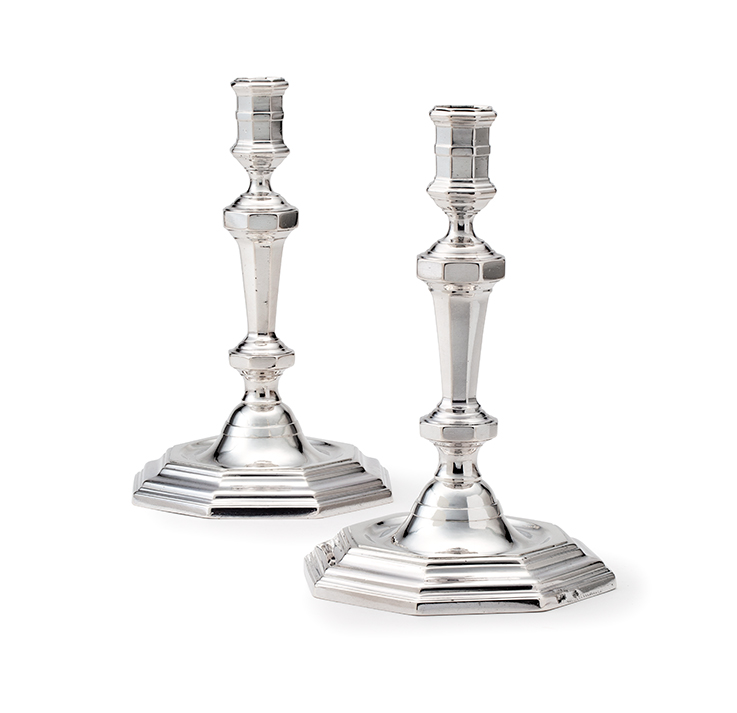
Dutch silver candlesticks
About This Project
Dutch silver candlesticks
Carolus Aegidius Hendrix
Roermond, circa 1740
966 grams; 20,3 cm high, diameter base 12,7 cm
Each candlestick on octagonal stepped base with lowered circular center has a knobbed tapering and facetted stem, headed by an octagonal spool sconce. Fully marked on the outer base rim and displaying an assay stripe.
Roermond silver is hallmarked with two marks only: the maker’s mark and the town hallmark, the lily. The lily was struck for silverware that met the legal standard. The date letter wasn’t struck on Roermond silver, due to the small number of silversmiths in the city. In 1749 there were only three master silversmiths in Roermond, namely Joannes Nicolaus Stahl, Joannes Matthei and Carel Aegidius Hendrix. Roermond silver is therefore very rare.
The silversmith
Only a few biographical details are known about Carolus Aegidius Hendrix, silversmith in Roermond, which are recorded in the publication Roermonds zilver (1982). It is known that he married twice. On 7 February 1727 with Anna Elisabeth Frios and on 12 August 1736 with Maria Anna Galjot. He is mentioned in the archives in the years 1736, 1749, 1750, 1757 and 1759. From 1750 he acted as a sworn coin assayer. His task was to determine the alloy and weight of various coins. He probably used two maker’s marks. The first, CH in cartouche with small lily as a town hallmark until ca. 1750. The second, CH in rectangle with larger lily as a town hallmark, from ca. 1750.
Carolus Aegidius Hendrix produced ecclesiastical silver and profane silver for civic guards, among others. His surviving ecclesiastical work includes a chrismatory, a ciborium, a crown for a statue of the baby Jesus, a pedestal of a cross, a number of chalices, a pyxis, a pair of ampoules and a crown for the statue of the Virgin Mary. The profane silverware includes a number of civic guard plates, now in the possession of the Schutterij St Andreas in Melick and the Schutterij St. Petrus in Roggel.
For more information, click here


