


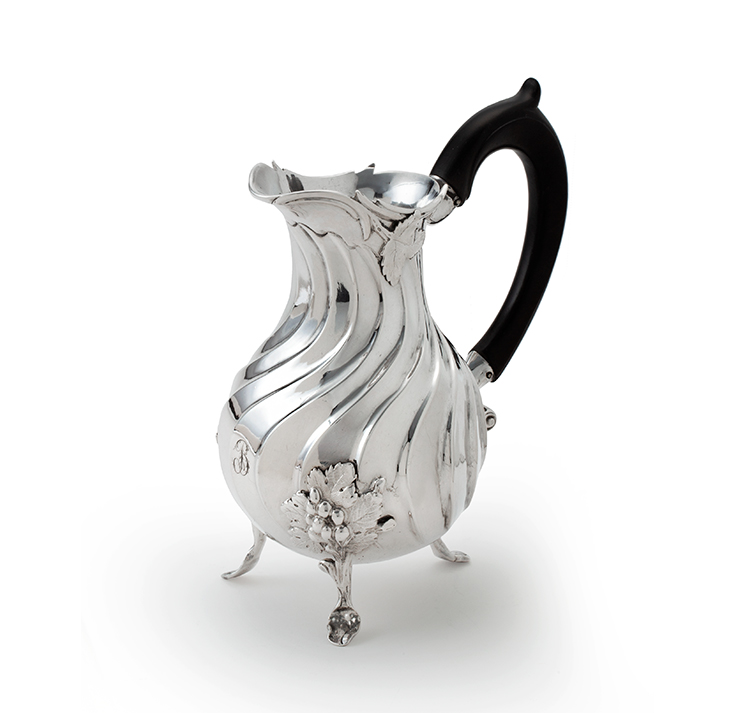
Dutch silver jug
About This Project
Dutch silver jug
Wilhelmus Angenendt
Amsterdam, 1787
226 grams all in; 14,5 cm high
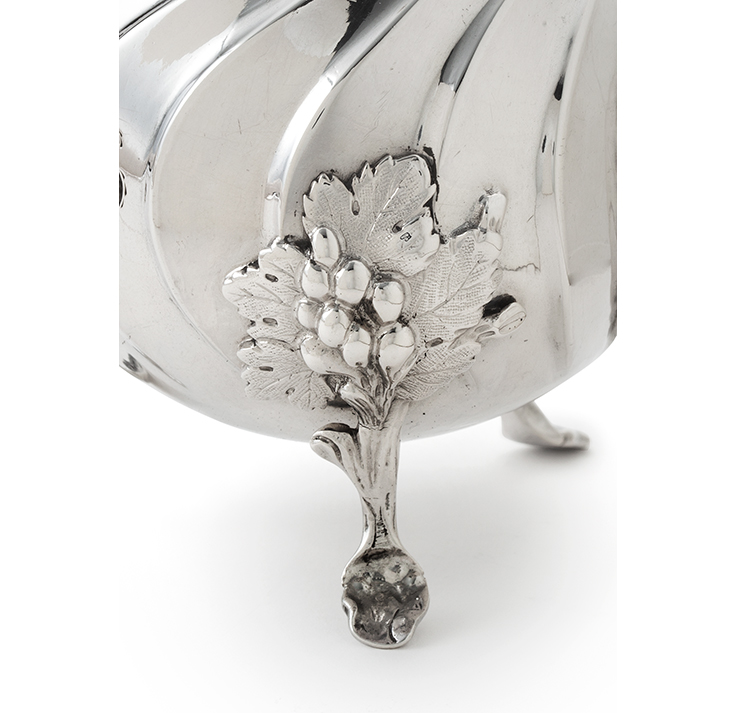
The baluster-shaped spirally fluted jug is raised on three scroll twig supports, headed by applied ornaments in the shape of matted vine leaves and grapes. The rim is shaped with c-scrolls and on either side applied with a vine leaf. The wood c-scroll handle is set in silver scrolls. Engraved with the letter B on the belly. Fully marked on the reverse and displaying assay stripes.
It is likely that this jug was not intended for milk, regarding its ornamentation of vine leaves and grapes. Presumably it was used for wine or edik, a fortified wine/vinegar with herbs and spices, which used to be a common commodity in the past.
In 1737 Wilhelmus Angenendt was born in Büderich Moers, near Duisburg and Wesel in Germany.. He was the son of van Wenceslaus by his wife Christina Ingenlandt. Wilhelmus left Germany for Amsterdam, where he became an apprentice in Johannes Schiotling’s silver workshop. He was the only catholic there. In 1770 he became a master-silversmith himself, established his workshop in Warmoesstraat in Amsterdam and in 1772 he married Catharina Gaardeman. In 1798 he closed his workshop and opted for a career in the army. Thus he left for the Dutch Antilles, where he died in 1817.
Angenendt was a productive silversmith, specialising in service work, of which three items are in the collection of Museum Boymans Van Beuningen in Rotterdam: a table bell, a jug and an inkstand. Also worth mentioning is a silver-gilt Thora finial in the Jewish Historical Museum, Amsterdam, made by Angenendt in 1775, one of his earlier works.
For more information, click here


